

TL;DR: Key Takeaways
The Four-Faith F-G100 is the best industrial IoT gateway for most sites: it is the only unit here combining 5G/LTE Cat 20, five RS485 ports, and built-in Modbus/IEC 60870-5-104 conversion in a single DIN-rail box, which makes it the pick for multi-site factory automation with large serial device counts and for energy and utility monitoring that needs cellular redundancy.
The Milesight EG71 is the better choice when the protocol mix changes rather than the port count: it bridges KNX, M-BUS, and LoRaWAN alongside Modbus/BACnet, so it fits smart buildings pairing HVAC control with Modbus meters and LoRaWAN sensors, and energy management sites that want protocol conversion in one box.
The Four-Faith FGI100-Lite covers the budget end, with 100+ supported protocols and dual-SIM redundancy in the smallest footprint of the three, best for single-PLC or single-meter remote sites and cost-constrained rollouts across many small locations.
This guide reviews all ten gateways across factory automation, energy, utility, and building automation use cases, with full specs, honest drawbacks, and clear guidance on which device fits which site.
- Four-Faith F-G100 is the strongest all-round pick – the only gateway here combining 5G/LTE Cat 20, five RS485 ports, and built-in Modbus/IEC 60870-5-104 protocol conversion in a single DIN-rail unit.
- Milesight EG71 – best for building automation and multi-protocol sites needing KNX, M-BUS, and LoRaWAN alongside Modbus/BACnet.
- Four-Faith FGI100-Lite – best for compact, budget-conscious edge deployments needing 100+ protocol support without the larger unit’s port count.
- Teltonika TRB140 – compact 4G LTE gateway with a single Ethernet port, Modbus/OPC UA support, and the broadest global regulatory approval list here.
- Advantech ECU-1251 – 4-port serial multi-protocol gateway (Modbus/BACnet/IEC 60870/DNP3) with cellular add-in card option.
- Moxa MGate MB3170 – dedicated Modbus TCP-to-serial protocol gateway with marine/hazardous-location certifications.
- Robustel EG5100 – Debian-based edge computing gateway with dual-SIM cellular and Docker container support.
- Advantech ECU-1270 – higher-tier quad-core edge gateway with Gigabit Ethernet and expansion slots for future modules.
- InHand Networks IG502 – dual-SIM industrial gateway with EtherNet/IP and IEC 61850-3 support for utility sites.
- Moxa MGate 5192 – specialist IEC 61850-to-Modbus/DNP3/IEC 101/104 substation protocol gateway.
Comparison Table Best Industrial IoT Gateways
| # | Brand/Model | Dimensions/Weight | Protocols | Interfaces | Power Input | Operating Temp | Value |
|---|---|---|---|---|---|---|---|
| 1 | Four-Faith F-G100 | 172×122×38mm, 700g | Modbus RTU/TCP, IEC 60870-5-104 | RS232 + 5×RS485, 4×GbE LAN + 1×GbE WAN, dual SIM, opt. WiFi | DC 9–36V | −35 to +75°C | |
| 2 | Milesight EG71 | 123×90×36mm, 375.6g | Modbus RTU/TCP, BACnet MS/TP, BACnet/IP, KNX, MQTT(s), HTTP(s) | 2×RS485, KNX, M-BUS, LoRaWAN, 2×GbE, WiFi, opt. 4G | 24V DC/AC, PoE, 5V USB-C | −40 to +60°C | |
| 3 | Four-Faith FGI100-Lite | 99 × 73 × 27 mm, 247g | Modbus, Mitsubishi, OPC UA + 100+ | RS232 + RS485, 2×Ethernet, dual SIM | DC 9–36V | −35 to +75°C | |
| 4 | Teltonika TRB140 | 74.5×25×64.4mm, 134g | Modbus TCP, OPC UA, MQTT, DLMS | 1×GbE RJ45, 1×DI/1×DO, 1×SIM | DC 9–30V | −40 to 75°C | |
| 5 | Advantech ECU-1251 | 140×30×96.5mm | Modbus RTU/TCP, IEC 60870-5-101/104, OPC-UA, DNP3, BACnet/IP | 4×RS232/485, 2×10/100 LAN, Mini-PCIe | DC 10–30V | −40 to 70°C | |
| 6 | Moxa MGate MB3170 | 29×89.2×124.5mm, 360g | Modbus TCP/RTU/ASCII | 1×serial, 2×10/100 RJ45 | DC 12–48V | 0–60°C / −40–75°C (wide) | |
| 7 | Robustel EG5100 | 49×105×128mm, 567g | Modbus RTU-to-TCP | 2×RS232/485, 2×DI+2×DO, 2×10/100 RJ45, opt. WiFi/BLE/GNSS | DC 9–60V | −40 to 70°C | |
| 8 | Advantech ECU-1270 | 140×32×93mm | Modbus RTU/TCP, OPC-UA, DNP3, IEC 60870-5-101/104, BACnet/IP | 2×RS232/485, 2×GbE, USB 3.0, mPCIe + M.2 | DC 10–36V | −40 to 70°C | |
| 9 | InHand IG502 | 110×127×35mm, 420g | Modbus RTU/TCP, OPC UA, EtherNet/IP, IEC 101/104, DNP3 | 1×RS232+1×RS485, 2×10/100 Eth, opt. DI/DO, dual SIM | DC 12–48V | −20 to 70°C | |
| 10 | Moxa MGate 5192 | 25×90×129.6mm, 294g | IEC 61850 MMS, Modbus RTU/TCP, IEC 60870-5-101/104, DNP3 | 1×serial, 2×10/100 RJ45, dual DC power | DC 12–48V | −40 to 75°C |
What Is an Industrial IoT Gateway?
An industrial IoT gateway is a hardware device deployed at the industrial site, near the data source – not a cloud service. Top industrial IoT gateways act as bridges between field assets and cloud systems, connecting industrial devices like PLCs, sensors, meters, and controllers to cloud platforms, local servers, or SCADA systems.
Core functions include:
- Data acquisition across multiple protocols (Modbus RTU/TCP, BACnet, IEC 60870, DNP3, OPC UA, MQTT)
- Protocol conversion and data normalization – translating between incompatible device languages so that data is standardized for cloud consumption and edge actionability
- Edge processing – industrial IoT gateways process data near the source, enabling real time data collection and low-latency decision-making. Edge devices can immediately act on detected anomalies, and local data analysis reduces strain on cloud resources. Data can even be buffered at the edge during cloud outages
- Secure transmission – including encryption, secure boot features, robust firewalls, and digital certificates. IoT gateways act as checkpoints to safeguard sensitive information across industrial networks
The problem these devices solve is device heterogeneity. Legacy systems using Modbus RTU can’t natively talk to a cloud platform expecting MQTT. Legacy devices running BACnet MS/TP won’t feed data into an IEC 60870-5-104 SCADA without translation. IIoT gateways feature edge computing and protocol conversion capabilities to bridge that gap, ensuring seamless connectivity among industry networks.
This is different from a plain industrial router or modem. A router provides point-to-point IP connectivity only. A gateway does protocol conversion and hosts multiple downstream devices via LAN, serial, or fieldbus – enabling reliable communication between diverse industries’ equipment and modern enterprise systems.
Typical deployment contexts: factory automation, energy and utility monitoring, building automation, and remote equipment monitoring of distributed assets. IIoT gateways enable real-time visibility into production performance, helping tackle production problems immediately and reducing waste through process optimization. Data from IIoT gateways standardizes communication across connected devices, while IIoT gateways support condition-based and predictive maintenance strategies through continuous real time data collection.
1. Four-Faith F-G100 - Best Overall Industrial IoT Gateway
Certified IoT Provider
F-G100 - Get The Best PriceThe Four-Faith F-G100 is available to buy from EasyNet Technologies, an authorised Four-Faith distributor.
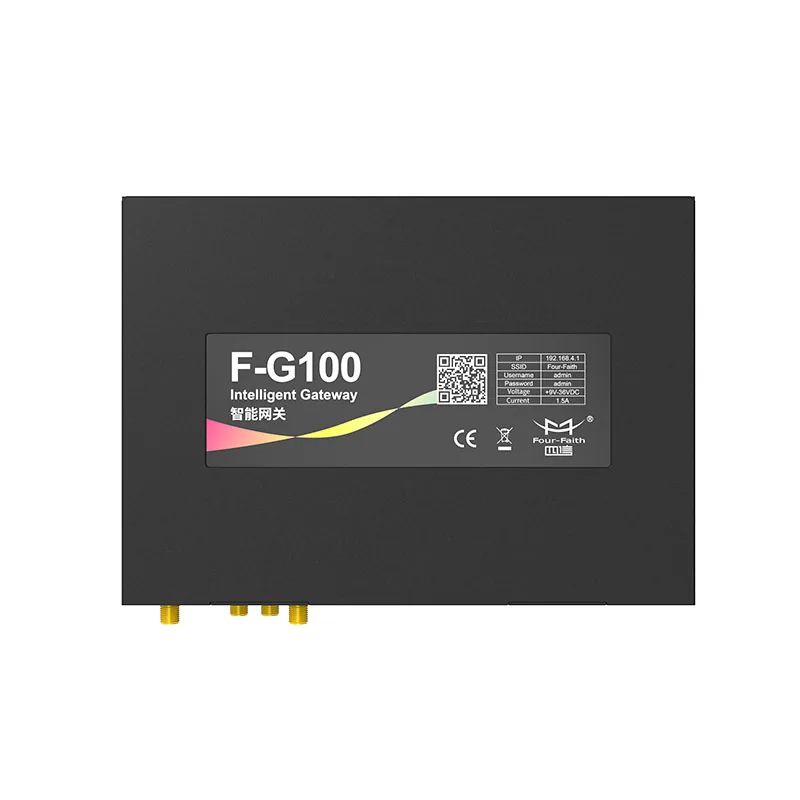
The F-G100 is a DIN-rail-mounted intelligent gateway from Four-Faith, positioned by EasyNet Technologies for industrial automation, energy/utilities, and remote monitoring deployments where both cellular backhaul and multi-device serial connectivity are non-negotiable.
Key specifications:
- Serial
- 1× RS232 + 5× RS485 (one shared with RS232), 2400–115200 bps
- Ethernet
- 4× Gigabit LAN + 1× Gigabit WAN, 1.5 kV ESD protection
- Cellular
- 5G NR (DL 3.4 Gbps / UL 350 Mbps), LTE Cat 20 (DL 2.0 Gbps / UL 150 Mbps), dual SIM
- I/O
- 2× DI (5–30 VDC), 1× DO, 1× relay output (1A 250 VAC / 30 VDC)
- Protocols
- Modbus RTU/TCP, IEC 60870-5-104
- Power
- DC 9–36 V, <1.2 A at 12 V; IP30 metal enclosure
- Environment
- −35 to +75°C operating, −40 to +85°C storage
Benefits
Highest serial port count in this list (six total) – connects the most field devices without an expansion module. The 5G SKU (F-G100-5G) carries 5G NR and LTE Cat 20 fallback on one module, so a site can start on LTE and move to 5G without changing hardware. The F-G100-4G is a separate SKU and does not offer this. Built-in Modbus/IEC 60870-5-104 conversion eliminates the need for a separate protocol gateway. Dual SIM support provides connectivity reliability for remote sites, which is critical for scalable deployment across distributed assets.
Drawbacks
No BACnet or KNX support, so it won’t suit building-automation deployments. No expansion slots for future protocol additions.
Best For
- Multi-site industrial automation with large serial device counts
- Energy and utility monitoring requiring cellular redundancy and remote monitoring
- Remote monitoring installations where 5G backhaul is available or planned
2. Milesight EG71 - Best for Building & Multi-Protocol Automation
Certified IoT Provider
EG71 - Get The Best PriceThe Milesight EG71 is available to buy from EasyNet Technologies, an official Milesight value-added distributor.
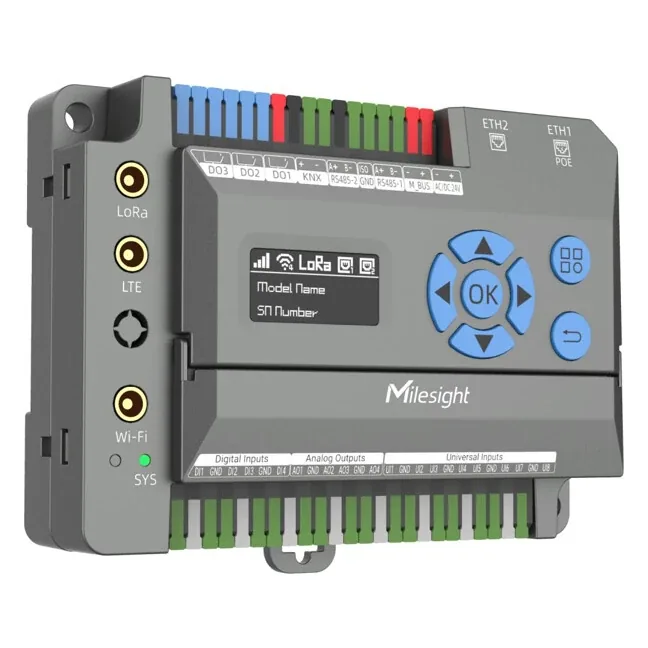
The EG71 from Milesight is a building and industrial IoT gateway positioned by EasyNet Technologies for sites mixing serial, KNX, M-BUS, and LoRaWAN devices under one protocol-conversion hub with edge I/O built in.
Key specifications:
- Ethernet
- 2× RJ45 Gigabit (WAN/LAN switchable), 1.5 kV isolation
- Field connectivity
- 2× RS485 (up to 256 devices), 1× KNX TP1 (up to 63 devices), 1× M-BUS (up to 20 devices, under development), LoRaWAN (~2,000 devices at 10-min uplink)
- I/O
- 8× universal input (digital/analog/RTD/NTC), 4× dry-contact DI, 3× relay output, 4× analog output
- Protocols
- Modbus RTU, BACnet MS/TP, KNX, BACnet/IP, Modbus TCP; forwarding via MQTT(s), HTTP(s)
- Power
- 24 V DC/AC, 802.3af PoE, or 5 V USB-C; typical 8.2 W
- Environment
- −40 to +60°C operating; CE, CE (RED), FCC
Benefits
Only gateway in this list bridging KNX, M-BUS, and LoRaWAN alongside Modbus/BACnet – avoiding separate iot gateways per protocol. Widest I/O mix (8 universal inputs + relays + analog outputs) for direct sensor data wiring. PoE power simplifies cabling in building installations, enabling seamless integration with existing systems.
Drawbacks
M-BUS support is under development – confirm status before specifying for a metering project. No 5G option (4G LTE Cat 1/GSM only, optional). Narrower operating temperature range (−40 to +60°C) than most DIN-rail industrial gateways here.
Best For
- Smart building sites combining BACnet/KNX HVAC control systems with Modbus meters and LoRaWAN sensors
- Energy management deployments needing data aggregation and protocol conversion in one box
- HVAC integrators standardizing on a single gateway across multiple building protocols
3. Four-Faith FGI100-Lite - Best Compact Edge Gateway for Budget Deployments
Certified IoT Provider
FGI-100 - Get The Best PriceThe Four-Faith FGI100-Lite is available to buy from EasyNet Technologies, an authorised Four-Faith distributor.
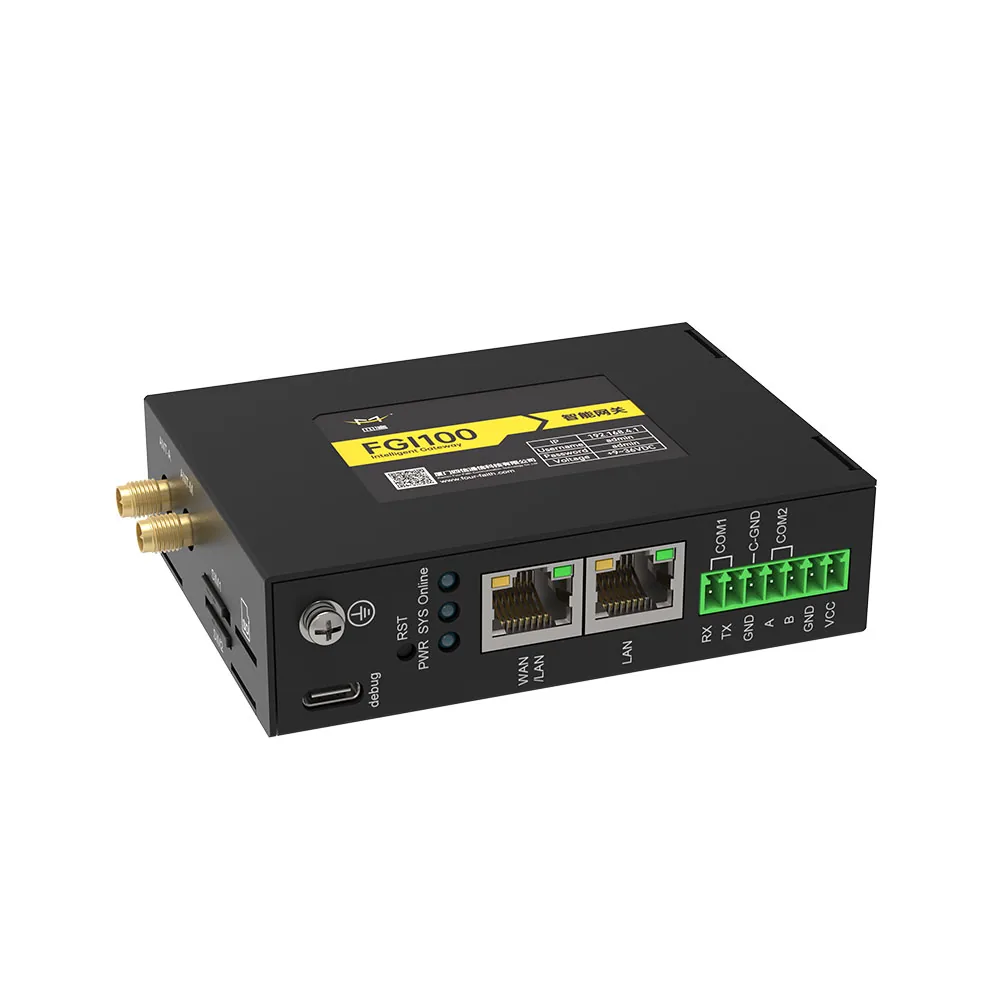
The FGI100-Lite is Four-Faith’s lighter, more budget-conscious alternative, positioned by EasyNet Technologies for sites needing broad protocol support without the F-G100’s port count.
Key specifications:
- Power
- DIN-rail mount, DC 9–36 V input, low power consumption (<3 W under LTE)
- Interfaces
- 2× Ethernet (10/100 Mbps), RS232 + RS485, dual Nano-SIM
- Protocols
- Modbus, Mitsubishi, OPC UA, plus 100+ total supported protocols
- CPU
- triple ARM Cortex-A7 @ 1.2 GHz, 128 MB RAM, 128 MB flash
Benefits
Broadest named protocol library by count (100+) in the smallest footprint of the three EasyNet Technologies gateways. Dual-SIM redundancy at a lower price tier enables reliable connectivity for budget-constrained rollouts. The low power consumption makes it practical for production environments with limited power budgets.
Drawbacks
Fewer serial ports (1×RS232 + 1×RS485) than the F-G100’s six. Ethernet limited to two 10/100 Mbps ports.
Best For
- Single-PLC or single-meter remote sites where a compact footprint matters
- Budget-constrained rollouts across many small sites needing basic protocol conversion
- Deployments already served by a separate network switch on the local network
4. Teltonika TRB140 - Compact 4G Industrial Gateway
A compact industrial 4G cellular iot gateway from Teltonika, built on RutOS (OpenWrt-based) for sites needing a single ruggedized connectivity point with light protocol conversion.
- Dimensions
- 74.5 × 25 × 64.4 mm, 134 g
- Ethernet
- 1× RJ45 Gigabit; Cellular: 4G LTE Cat 4, single SIM
- I/O
- 1× DI, 1× DO; Protocols: Modbus TCP, OPC UA, MQTT, DLMS
- Environment
- −40 to 75°C; Certifications: CE, UKCA plus 16 named regional approvals
Benefits
Smallest footprint of any gateway here. Broadest global regulatory approval list – useful for multi-country rollouts needing one SKU. DLMS support (utility-meter data exchange) is absent from most other gateways in this comparison. Advanced security measures include IP login blocking and robust firewalls standard in the RutOS platform.
Drawbacks
Single Ethernet port only. No native RS232/RS485 serial port. 4G only, no 5G option.
Where It’s Used
- Single-device wireless connectivity in limited panel space
- Multi-country deployments across diverse industries needing broad regulatory coverage
- Utility metering sites using DLMS over cellular backhaul
5. Advantech ECU-1251 - Multi-Protocol Serial Communication Gateway
Advantech offers ruggedized, modular gateway solutions for harsh environments, and the ECU-1251 targets sites needing simultaneous conversion across multiple SCADA protocols from four wired serial devices.
- Serial
- 4× RS-232/485 isolated; Ethernet: 2× 10/100 Mbps; Expansion: Mini-PCIe for WiFi/3G/4G
- Protocols
- Modbus RTU/TCP, IEC 60870-5-101/104, OPC-UA, DNP3.0, BACnet/IP (client and server modes)
- Environment
- −40 to 70°C; Certifications: CE, FCC Class A, RED
Benefits
Widest SCADA protocol list in this port-count tier with both client and server modes. Cellular is modular (Mini-PCIe) – choose or skip the radio per site. Modular design supports scalable solutions for fleet-wide deployments.
Drawbacks
Cellular requires purchasing a separate Mini-PCIe module. Only 2 Ethernet LAN ports. No native WiFi or built-in SIM slot.
Where It’s Used
- SCADA integrators needing simultaneous Modbus, DNP3, and IEC 60870 conversion
- Utility/energy monitoring requiring client and server protocol modes
- Sites wanting to seamlessly integrate legacy assets into modern SCADA
6. Moxa MGate MB3170 - Modbus TCP-to-Serial Protocol Gateway
Moxa specializes in industrial connectivity and edge solutions for mission-critical settings. The MGate MB3170 is a dedicated single-port Modbus gateway for TCP/ASCII/RTU conversion.
- Serial
- 1× port RS-232 on DB9 male, RS-422/485 on terminal block, software selectable; 50 bps to 921.6 kbps.
- Ethernet
- 2× 10/100 RJ45 (cascade supported); Protocols: Modbus TCP Client/Server, Modbus RTU/ASCII Master/Slave; up to 32 TCP connections
- Environment
- 0–60°C standard / −40–75°C wide-temp; Certifications: CE, FCC, IECEx, DNV
- MTBF
- 1,662,526 hours; 5-year warranty
Benefits
Highest Modbus TCP connection ceiling (32 simultaneous). Marine/hazardous-location certification (DNV, IECEx) unique in this comparison. Ethernet cascading eliminates separate switches, which delivers operational efficiency in retrofitting legacy Modbus equipment.
Drawbacks
Modbus only – no BACnet, IEC 60870, DNP3, or OPC UA. No cellular. Single serial port.
Where It’s Used
- Dedicated Modbus TCP-to-serial bridge for consistent performance in data collection
- Marine, offshore, or hazardous-location installations requiring DNV/IECEx
- Retrofitting legacy devices onto Ethernet SCADA networks
7. Robustel EG5100 - Linux-Based Edge Computing Gateway
A Debian-based industrial edge computing gateway from Robustel with dual-SIM cellular and container support for buyers wanting to run custom applications on the device itself.
- CPU
- ARM Cortex-A7, 792 MHz; 1 GB DDR3 RAM; 8 GB eMMC; Docker support (Debian 11)
- Cellular
- 4G/3G/2G, dual SIM; EU LTE bands confirmed (14 FDD + 4 TDD)
- Serial
- 2× RS-232/485; I/O: 2× DI + 2× DO; Ethernet: 2× 10/100 Mbps
- Protocols
- Modbus RTU-to-TCP; Environment: −40 to 70°C
Benefits
Only gateway here running a full Debian Linux OS with Docker – enabling edge computing capabilities for custom containerized applications and advanced analytics. Confirmed EU LTE band list explicitly documented. Dual-SIM [failover](/glossary/failover/) standard.
Drawbacks
Requires Linux development capability – not a configure-and-forget device for non-technical buyers. Protocol conversion limited to Modbus RTU-to-TCP. Widest footprint among compact gateways (128 mm length).
Where It’s Used
- Systems integrators running custom edge applications for analyzing data at the industrial edge
- Multi-carrier deployments needing confirmed EU dual-SIM coverage
- Retrofit projects aggregating RS-485 devices before LTE backhaul
8. Advantech ECU-1270 - Quad-Core Expandable IoT Gateway
A higher-tier expandable industrial IoT gateway from Advantech for sites needing more compute headroom and expansion capacity than the entry ECU-1251.
- CPU
- TI AM6734 Quad Cortex-A53, up to 1.4 GHz; 2–4 GB LPDDR4 (expandable to 8 GB); 16–32 GB eMMC
- Ethernet
- 2× Gigabit; Serial: 2× RS-232/485; Expansion: mPCIe + M.2 E-key 2230
- Protocols
- OPC-UA, DNP3.0, IEC 60870-5-104/101, Modbus RTU/TCP, BACnet/IP
- Environment
- −40 to 70°C; Certifications: CE, FCC, cUL, CB, RoHS, UKCA
Benefits
Gigabit Ethernet on both ports combined with a quad-core CPU – robust performance and the most compute headroom here. Dual expansion slots (mPCIe + M.2) allow future wireless connectivity upgrades without replacing the unit. RAM expandable to 8 GB – highest ceiling in this comparison, supporting digital transformation workloads at the edge.
Drawbacks
Higher price point for sites that don’t need the extra compute. Fewer serial ports (2) than the F-G100 (6). Cellular optional and module-dependent.
Where It’s Used
- Sites running edge analytics or machine data processing alongside protocol conversion
- Deployments wanting expansion headroom for future cellular or WiFi modules
- Higher-throughput environments needing Gigabit Ethernet for reliable performance
9. InHand Networks IG502 - Industrial Gateway with EtherNet/IP Support
The InHand IG502 combines dual-SIM cellular with a wide range of industrial protocols, including EtherNet/IP and IEC 61850-3 support not common at this size/price tier.
- CPU
- ARM Cortex-A8, 600 MHz; 512 MB RAM; 8 GB eMMC
- Serial
- 1× RS-232 + 1× RS-485 (or 2× RS-485); Ethernet: 2× 10/100 Mbps; Optional I/O: 4× DI + 4× DO with 3,000 VDC isolation
- Protocols
- Modbus RTU/TCP, OPC UA, EtherNet/IP, IEC 101/104, DNP3.0, plus 80+ additional via DeviceSupervisor
- Environment
- −20 to 70°C; Certifications: CE, UKCA, FCC, IEC 62443-4-2, IEC 61850-3
Benefits
EtherNet/IP support is uncommon at this tier – relevant for Allen-Bradley/Rockwell PLC sites enabling predictive maintenance and remote diagnostics through native protocol access. IEC 62443-4-2 cybersecurity certification and IEC 61850-3 environmental certification add credibility for critical infrastructure buyers. The 3,000 VDC isolation on optional I/O is higher than most gateways here. Many gateways support remote management for enhanced security control, and the IG502 is no exception – offering remote access via cloud integrations with AWS and Azure.
Drawbacks
Narrower operating temperature range (−20 to 70°C) than most DIN-rail gateways here. Full protocol depth (80+) requires the optional DeviceSupervisor add-on. Digital I/O is optional, not standard.
Where It’s Used
- Sites with Allen-Bradley/Rockwell PLCs needing native EtherNet/IP conversion for industrial applications
- Utility or critical operations deployments wanting IEC 62443-4-2 cybersecurity certification
- Moderate-climate installations where asset management and device management are priorities
10. Moxa MGate 5192 - IEC 61850 Substation Protocol Gateway
The MGate 5192 is a specialist protocol gateway built specifically to convert IEC 61850 substation devices into Modbus, DNP3, or IEC 60870-5 formats – a narrower, deeper tool than the general multi-protocol gateways in this list.
- Serial
- 1× DB9 (RS-232/422/485 selectable), 2 kV isolation
- Ethernet
- 2× 10/100 RJ45, 1.5 kV isolation; Power: DC 12–48 V, dual redundant inputs
- Protocols
- IEC 61850 MMS Client (up to 32 server connections, 5,000 data objects); Modbus TCP/RTU/ASCII Server (5,000 tags); IEC 60870-5-101/104 Server (5,000 information objects); DNP3 Serial/TCP/UDP Outstation with Secure Authentication v5
- Environment
- −40 to 75°C; Certifications: CE, FCC, UKCA, cULus, IEC 61850-3, IEEE 1613
- MTBF
- 1,240,821 hours; 5-year warranty
Benefits
Only gateway in this list converting IEC 61850 into Modbus/DNP3/IEC 60870. IEEE 1613 and IEC 61850-3 certifications target power-substation environmental requirements and robust security features through DNP3 Secure Authentication. Dual redundant DC power inputs ensure reliable communication for critical equipment. IIoT gateways must have environmental ruggedness for harsh conditions, and this unit delivers with −40 to +75°C operation and full substation-grade compliance.
Drawbacks
Single serial port and narrow protocol focus. No cellular, WiFi, or edge-compute capability; I/O is limited to a single relay output. This is a dedicated protocol bridge, not a general edge device.
Where It’s Used
- Power substation and renewable-energy sites integrating IEC 61850 IEDs/relays into Modbus, DNP3, or IEC 60870 SCADA
- Utilities standardizing on IEEE 1613-rated hardware for industrial settings
- Sites requiring power-input redundancy for critical protection and industrial monitoring equipment
How to Choose the Right Industrial Gateway
Selecting from these industrial gateways comes down to matching your site’s requirements across several dimensions. Choose gateways that allow for easy scalability and modular upgrades where your iot infrastructure may expand.
- Protocol match first: Modbus only → MGate MB3170. IEC 61850 conversion → MGate 5192. Building protocols (BACnet/KNX) → EG71. Broad multi-protocol coverage → F-G100, ECU-1251, ECU-1270, or IG502. Leading IIoT gateways support protocols such as Modbus, OPC UA, and MQTT, but IIoT gateways often require extensive protocol support to connect various industrial devices – verify that your specific cloud friendly protocols and field protocols are included, not just listed.
- Serial device count: Sites with many individually-wired RS232/RS485 legacy assets need higher port counts (F-G100: 6 ports; ECU-1251: 4). Single-device sites can use the TRB140 or MGate MB3170.
- Cellular generation: 5G (F-G100), 4G Cat 4 (TRB140, EG5100), 4G Cat 1/Cat 4 (IG502), or no cellular at all (MGate MB3170, MGate 5192). For IIoT deployment, consider gateways with dual SIM support for connectivity reliability.
- Environmental range: “Operating ranges vary; storage ranges commonly run −40 to +85°C. Most DIN-rail units here reach −40°C on the low end, the exceptions are F-G100 and FGI100-Lite (−35°C), IG502 (−20°C), the standard MGate MB3170 (0°C, or −40°C on ‘-T’ models), and EG71, which tops out at +60°C. Select gateways with rugged designs for harsh industrial environments. Look for gateways with built-in security features like encryption and a trusted platform module where applicable.
- Edge compute needs: Only the Robustel EG5100 offers a full Linux/Docker environment. Edge computing reduces latency and bandwidth usage in data transmission – real-time data processing enables low-latency decision-making at the source. IIoT production monitoring reduces waste and optimizes processes when actionable insights are derived locally.
- EU/UK certification: Confirm CE/UKCA per product before specifying. CE/UKCA confirmed on TRB140, EG5100, ECU-1270, IG502, and MGate 5192. For Four-Faith F-G100 and FGI100-Lite, confirm the current EU/UK approvals with EasyNet Technologies before specifying. Remote management capabilities are important for large-scale IIoT deployments, so verify firmware update and fleet management support as well.
Frequently Asked Questions
What is the difference between an industrial IoT gateway and an industrial router?
A gateway does protocol conversion (e.g., Modbus RTU to MQTT) and hosts multiple downstream devices via LAN/serial. A router or IP modem provides point-to-point cellular connectivity only, without protocol translation. Gateways enables connectivity between control systems speaking different languages, ensuring seamless integration across iot deployments.
Which protocols do industrial IoT gateways typically support?
Common protocols include Modbus RTU/TCP, BACnet, IEC 60870-5-101/104, DNP3, OPC UA, IEC 61850, KNX, M-BUS, EtherNet/IP, and MQTT. No single gateway supports all of them – refer to the comparison table above for per-product coverage.
Do industrial IoT gateways need a cellular connection?
Not always. Gateways like the F-G100, EG71 (optional), TRB140, EG5100, and IG502 include cellular for remote sites. Specialist gateways like the MGate MB3170 and MGate 5192 are Ethernet/serial only, relying on a separate router for seamless connectivity where wired backhaul is unavailable.
What operating temperature range should an industrial gateway support?
Most DIN-rail units in this list rate to −40°C on the low end and +70–75°C on the high end. EG71 tops out at +60°C; IG502 starts at −20°C; both Four-Faith units (F-G100, FGI100-Lite) start at −35°C. Always confirm against your deployment site’s conditions – production data from sites with extreme temperature swings demands robust connectivity.
Can one gateway support both Modbus and BACnet?
Yes. The EG71 handles Modbus RTU, BACnet MS/TP, and BACnet/IP for data acquisition. The MGate MB3170 and MGate 5192, by contrast, are single-protocol-family specialists by design and cannot bridge both.
What is IEC 61850 and when does a site need a gateway that supports it?
IEC 61850 is the international standard for substation automation. A conversion gateway like the MGate 5192 is needed when integrating IEC 61850 IEDs/relays into a Modbus, DNP3, or IEC 60870-5 SCADA system – common in power substations and renewable energy sites serving as critical infrastructure. IIoT gateways facilitate monitoring of entire plants’ conditions in such deployments.
Is 5G necessary for an industrial IoT gateway?
Not a hard requirement. The F-G100 offers dual 5G/LTE Cat 20 for maximum bandwidth and redundancy, while 4G Cat 4 gateways (TRB140, EG5100) handle most industrial monitoring workloads. 5G matters when real time data volumes are high or when future-proofing for quality control and remote diagnostics workloads. Condition monitoring reduces reliance on calendar-based maintenance, and real-time data collection improves equipment health monitoring – but these don’t inherently require 5G bandwidth. Predictive maintenance can be achieved through condition monitoring over 4G in most cases. IIoT gateways enable condition-based maintenance strategies regardless of cellular generation.
What certifications should UK/EU buyers check before purchasing?
CE for EU, UKCA for UK. These are confirmed on the Teltonika TRB140, Robustel EG5100, Advantech ECU-1270, InHand IG502, and Moxa MGate 5192. For Four-Faith F-G100 and FGI100-Lite, confirm the current EU/UK approvals with EasyNet Technologies before specifying. Industrial IoT gateways include encryption and secure boot features as standard in most CE-certified units.
Need a shortlist for your site?
Send the application, the required interfaces and the delivery market. The team in Vilnius and London will confirm the models that fit.